
Why Power System Planning Software Is Broken
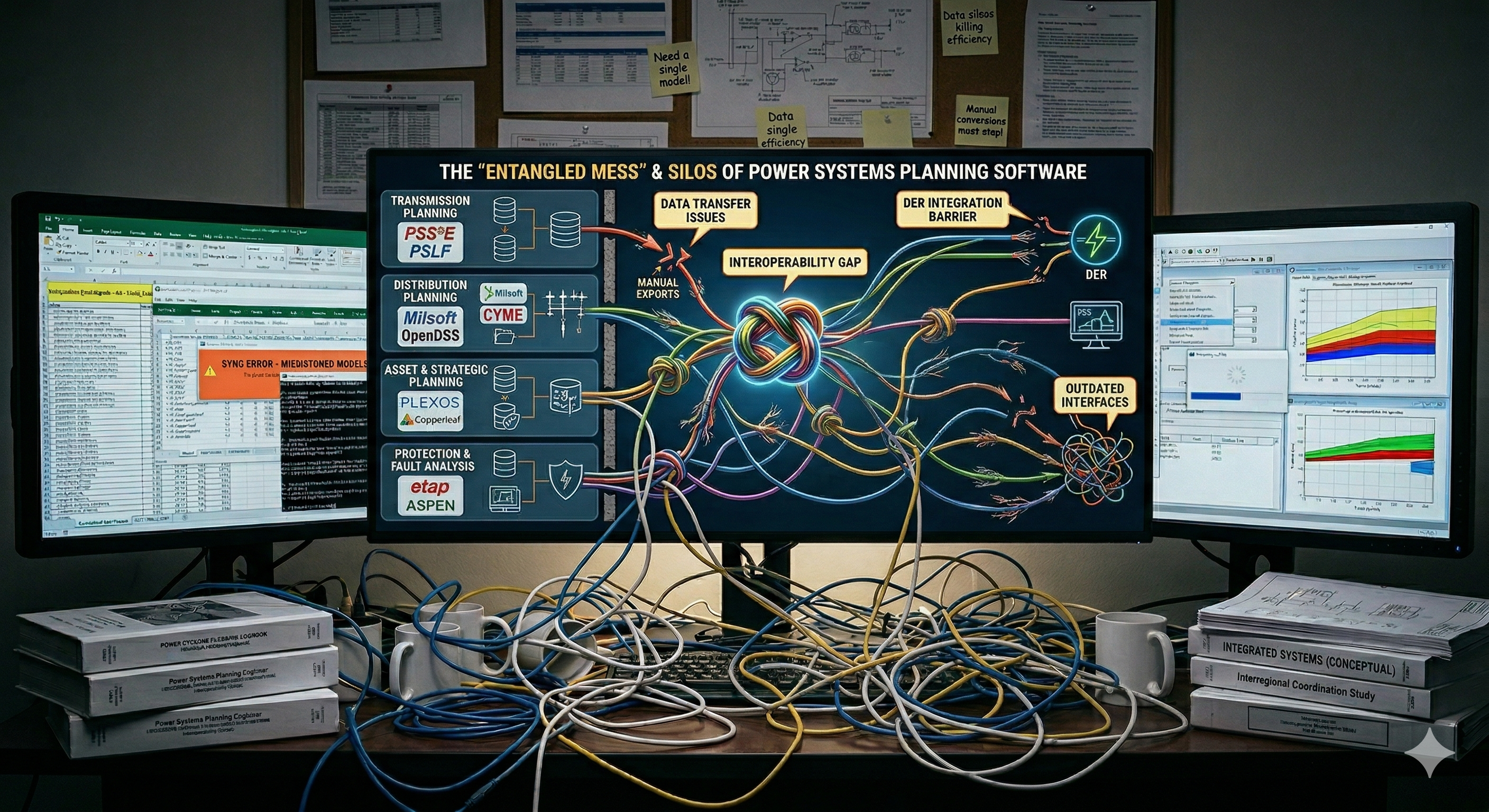
The tools used for integrated power system planning were built to work in isolation. Fixing them is not a computing problem — it's a software architecture problem with organizational roots.



Electric power systems are the most complex and large machines ever built and are critical to the functioning of society. However, the effects of electricity generation on the environment, particularly concerns about climate change, have sparked an increase in the adoption of zero-emission energy sources. Over the last 20 years, technological advances in PV panels and wind turbines have made renewable energy an economically viable way to power the grid. In a way, the challenge of developing technologies to exploit renewable energy resources competitively against fossil-fueled resources can be considered for all intends and purposes solved.
Nevertheless, these new sources of energy create new challenges when it comes to their integration into an electric power network designed to operate with thermal generation and small short term fluctuations in demand. Up to this date, the electric power system is operated under an over-arching presumption of total controllability of the resources and predictability of the load. Besides the changes in the primary energy sources used to generate electricity, the very principles of energy conversion that facilitate the energy transition are also changing. The system is slowly replacing large electrical machines that generate electrical power through a rotating electromagnetic field with power electronic interfaced resources that employ semiconductors to perform energy conversion by means of switching at high frequencies. However, the techniques to model,operate and plan power systems did not evolve much until the last ten years.
The inherent variability of renewable energy generation has impacts on various timescales that range from seconds to decades, and energy systems integration needs to be analyzed across timescales and domains accordingly.
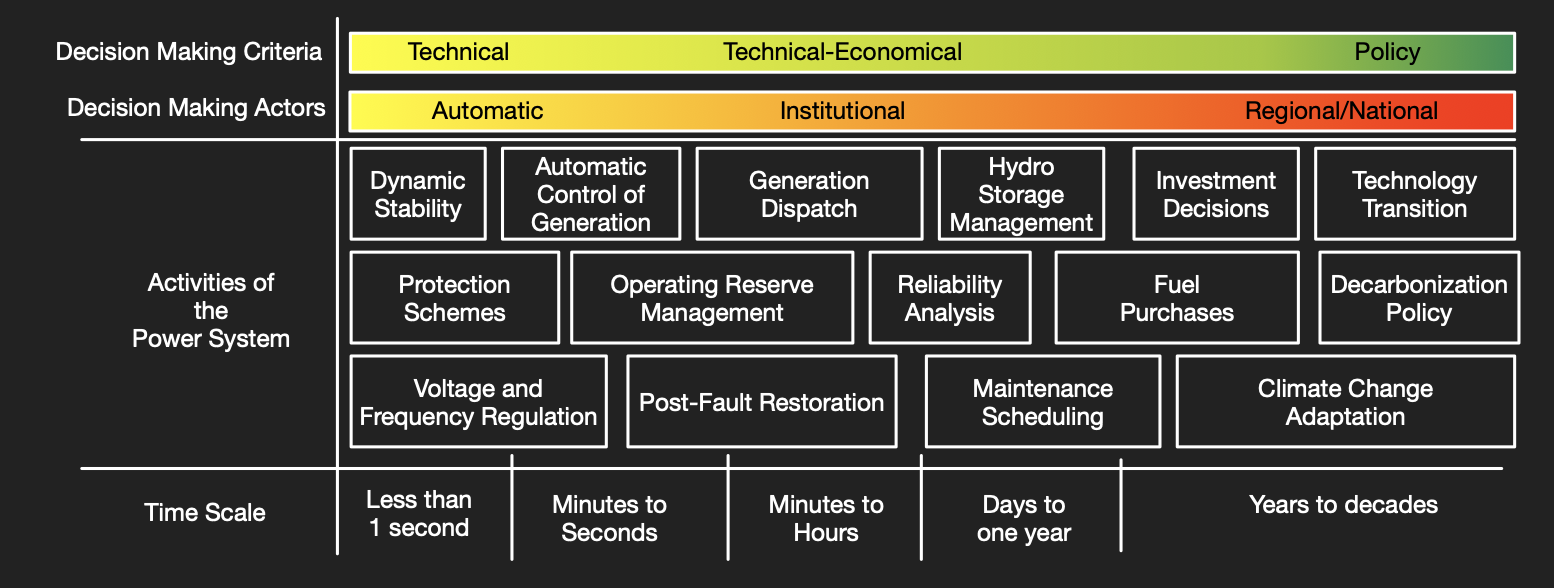 Figure 1: Time scales in power system operations
Figure 1 shows the different time scales in power systems and the decision-making characteristics at each stage. The capacity to understand the requirements to operate the grid under increased variability rests on improving the simulation capabilities necessary to build and test the integration of new devices and components.
The process of conducting a simulation concerns itself with acquiring knowledge about a system and employing an unambiguous, and possibly inexact, representation of its characteristics. The representation of the system is known as the model which is meant to enlighten about how the real system would behave given the conditions in the simulation. Given a model, it is necessary to define a simulation method that can answer the research question by means of finding the solution to the model.
The use of simulations in power systems has evolved with the changing needs of the grid, the development of new tools and increase in computational power. Formerly, the discipline relied heavily on mathematical analysis of lower-dimensional, deterministic systems and presented limited computer simulation results. However, thanks to increases in available computational power, optimization-based models and computer simulation are standard tools used for research in systems of all scales, from bulk generation and transmission to micro-grids.
It is possible to identify two major simulation categories in need to develop novel models, methodologies, and critically, improvements to the scientific practices.
Each simulation category has very distinct methods, practices and applications, hence, they need be treated differently and with specific focus on the challenges brought by the energy transition.
These simulations are concerned with decision making in the Days to Minutes time scale. The general objective of an operation simulation is to determine how to operate the system at a minimum cost while keeping certain reliability restrictions in place. Commonly these simulations employ discrete optimization models to find the solution of “optimal” operational decisions. Usually these simulations are framed as Integrated Resource Plans (IRP) or Production Cost Models (PCM).
Integrating renewable energy is a challenging problem from the operation point of view, given that forecasting of renewable energy resources introduces higher levels of uncertainty into the operations decision making. Further, given that modern lifestyles rely heavily on electricity provision, failing to hedge the system against uncertainty can result in disruptive losses of load, increased costs of power curtailment, or even system collapse. In this work, the focus begins in the minutes-to-hour time scales where short-term imbalances and variations pose a many operational challenges like increases ramping requirements to supply compensation flexibility for changes in the renewable energy, determination of reserve quantities and the integration of novel power generation resources like Renewable-Storage units.
From the operational perspective, managing the uncertainty in bulk electric power systems, is a well-recognized challenge. Yet, uncertainty is often crudely defined, which impedes the development of actionable and consistent practical approaches to addressing it. Therefore, it is important to define uncertainty in a functional sense and then proceed to apply that definition to activities concerning grid operations. An effective treatment of uncertainty requires a clear distinction between the inherent variability, often referred to statistical uncertainty, and the epistemic uncertainty due to the limited or lack of knowledge about the process.
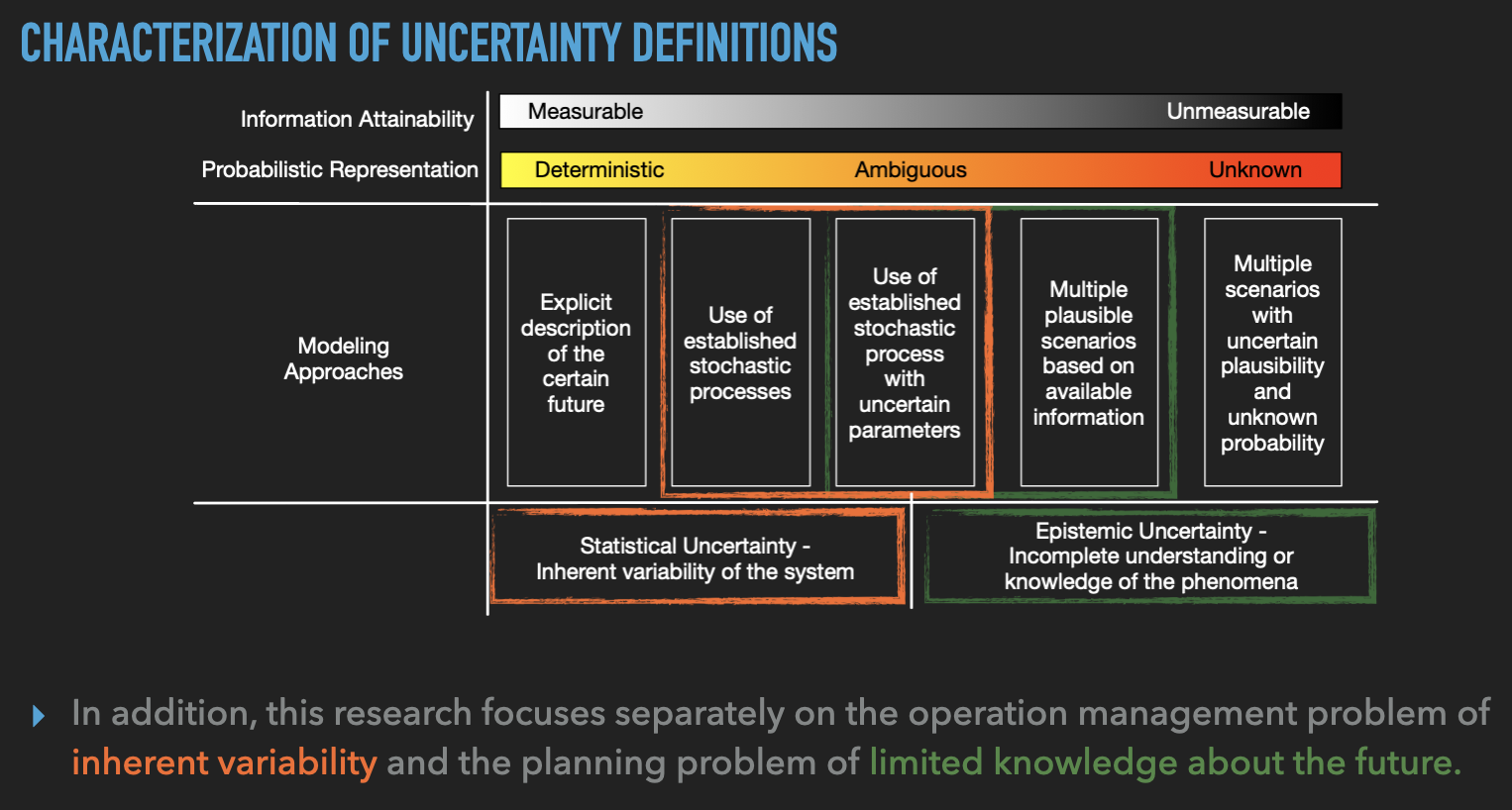 Figure 2: Uncertainty in power system operations
Uncertainty can be characterized accross different decision making domains as shown in Figure 2. On one end of the spectrum, there exist deterministic processes that can be measured and have little or no statistical uncertainty, for instance, load forecast with short look-ahead horizons. On the other hand, renewable energy output is more adequately characterized using probability models when available, for instance, wind power and solar average power forecasts. In the most extreme case of uncertainty there is long-term available resources and load, or the number of factors that determine long-term weather patterns, energy consumption, and possible technological transitions make the knowledge about the processes inherently incomplete. As a result of the epistemic uncertainties planning problems rely heavily on assumption and the impact of long term unknowns needs to managed carefuly to avoid making detailed structured simulation results useless.
The critical challenge of including uncertainty the simulation of power system operations is one of dimensionality. On the one hand, the inclusion of uncertainty in operation problems imposes a much larger space for the solution of optimization problems. On the other hand, the assessment of operational models can no longer be done just for peak, mid and low load operating points. This increased dimensionality in the problem size and the number of simulation scenarios under consideration requires the development of new computational techniques.
These simulations focus on representing the physical continuous time behavior of the system in the micro-second to minute time-scales. They are generally used to study the, broadly defined, “stability” of the system. These models are formulated as Ordinaty Differential Equations (ODEs) or Differential Algebracic Systems of Equations (DAEs) and employ numerical integration techniques to find the solution.
The increasing integration of generation sources via power electronics is changing the underlying dynamic behavior of power systems. It is generally agreed that new dynamics in the controls of Inverter Based Resources (IBRs) change modeling requirements for system-wide stability studies that rely on time-domain simulations. In power systems dominated by synchronous generators, physical phenomena (magnetic fluxes, electro-mechanics, mechanical control reaction times, or thermo-dynamic processes) drive dynamic behavior. The control logic associated with synchronous generators is commonly tuned to the timescale of the relevant processes, creating a natural separation between the dynamic behaviors attributable to physics and controls. On the other hand, inverter dynamics are dominated by their controls, including modulation, PLLs, voltage, current, and power controllers. Therefore, the practical requirements of control design—often, cascading PID control—defines the relationships between timescales. In fact, interactions at higher frequencies have recently been recognized with a new stability category, highlighting the exigent need to revisiting our understanding of system dynamics with high penetrations of generator interfaced via inverters.
Dynamic analysis of power systems resorts to mainly two computational numerical methods: (1) Time-domain simulations and (2) small-signal stability analysis. For many decades, there has been a focus on reducing time-domain simulations’ computational complexity through model order reductions and averaging methods. Some of the modeling practices and analytical assumptions currently in use derive from singular perturbation theory in the 1980s. The seminal papers showed that a simplified model is still a valid representation of certain system dynamics u nder the premise of time scale separation. However, the validity of these simplifications are being challenged with the addition of inverters to the system.
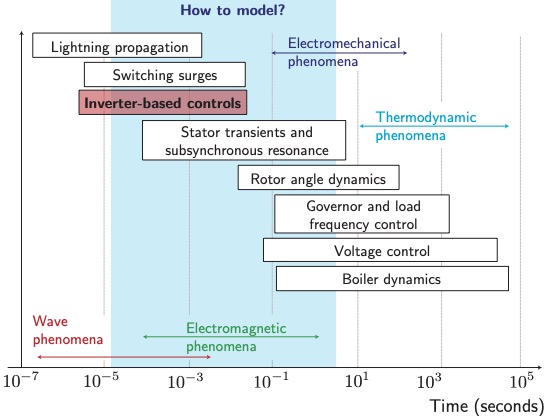 Figure 3: Time scale separation of dynamic phenomena in power systems
Figure 3 (modified from Definition and Classification of Power System Stability – Revisited & Extended1) highlights the frequency ranges of dynamic phenomena and modeling requirements to capture the system’s behavior, which is a zoom into the less than 1 - 10 second range of Figure 1. Inverter controls consider multiple models such as power electronics representation, phase-locked loop, voltage and current controllers, outer-loop controllers, that have wide timescale ranges, that complicates the determination of which level of model complexity has to be used.
The new demand for larger scales and more details in modeling requires changing how we approach developing simulation experiments. The critical challenge in dynamic simulations is the addition of phenomena that heretofore has not being included imposing new requirements on the solvers and as a result on the computational requirements. Increasing the level of detail in dynamic simulations requires new approaches to obtain reliable system assessments and use better computational tools. The power system sector needs to accelerate the adoption of recent improvements in algorithms and hardware.
In this sense, understanding the short-term dynamics of the power system is crucial for identifying potential issues or challenges that may arise during the integration of renewable energy and for designing control strategies to address them.
The technological changes required to transition the electricity supply from a fossil fueled power system to one that is powered by renewable energy requires significant improvements in the methods and models used to simulate the grid. The increasing reliance on computer simulations for the study and development of novel technologies requires the adoption of new methods and practices to study how the grid will evolve. More often than not “classical approaches” will become less effective in providing accurate results about how a decarbornized system will operate.
N. Hatziargyriou et al., “Definition and Classification of Power System Stability – Revisited & Extended,” in IEEE Transactions on Power Systems, vol. 36, no. 4, pp. 3271-3281, July 2021, doi: 10.1109/TPWRS.2020.3041774. ↩
The tools used for integrated power system planning were built to work in isolation. Fixing them is not a computing problem — it's a software architecture problem with organizational roots.
Wittgenstein's philosophy of language illuminates why semantic clarity in power systems modeling matters — from Sienna's type system to the failures of CIM and the preconditions for trustworthy AI.
The most critical deisgn aspect you have never heard of in Power Systems. Excerpt from PowerSystems.jl — A power system data management package for large scale modeling